Pot of Gold ingredients articles
Here you will find more information on our ingredients. 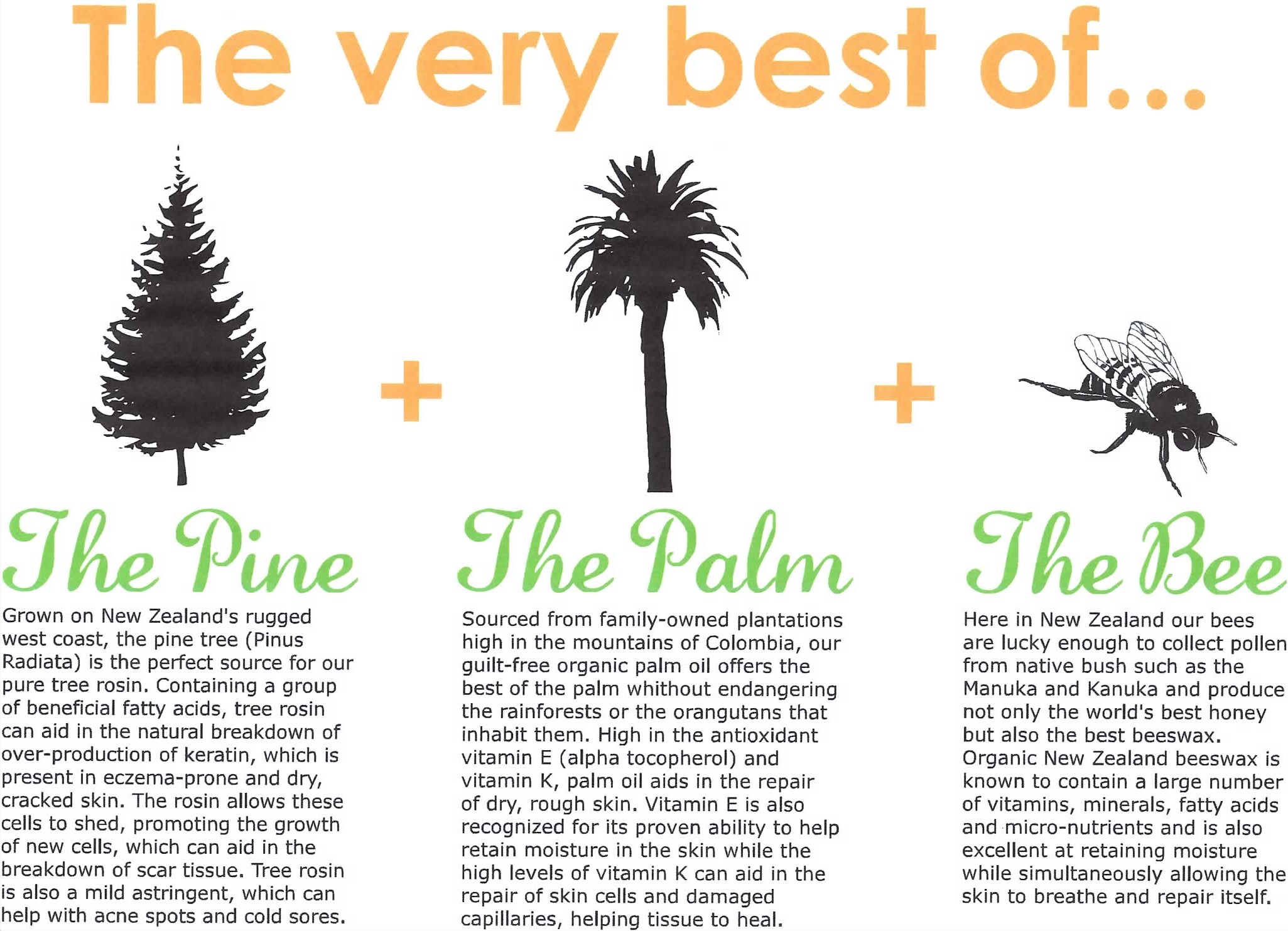
Beeswax
Here in New Zealand our bees are lucky enough to collect pollen from native bush such as the Manuka and Kanuka and produce not only the world's best honey but also the best beeswax. Organic New Zealand beeswax is known to contain a large number of vitamins, minerals, fatty acids and micro-nutrients and is also excellent at retaining moisture while simultaneously allowing the skin to breathe and repair itself.
All beeswax used in our products is certified organic and locally produced.
Beeswax must be one of the most misunderstood cosmetic ingredients. Some people immediately call to mind a picture of a heavy and very solid wax when thinking of beeswax. This is incorrect and beeswax has very wonderful properties when correctly used and included in skin care formulas.
 Primitive people knew and used beeswax as an antiseptic and for wound healing. It works well in cosmetic products because of compounds called 'wax esthers' that exist in both beeswax and human skin. This hydrating pure natural skin care ingredient increases skins essential moisture keeping skin naturally moisturised. Primitive people knew and used beeswax as an antiseptic and for wound healing. It works well in cosmetic products because of compounds called 'wax esthers' that exist in both beeswax and human skin. This hydrating pure natural skin care ingredient increases skins essential moisture keeping skin naturally moisturised.
People with acne sometimes incorrectly think that it is a comedogenic ingredient (an ingredient that promotes the formation of acne and pimples), whereas it actually has an irritation potential of zero, and a comedogenicity rating of 0-2, which means that when it is properly used it will NOT promote the formation of acne or pimples.
When formulated and used correctly in cosmetic formulations, beeswax will not cause a problem or clog the pores, but instead bring a host of very positive attributes, such as healing and antiseptic properties, as well as emollient and softening qualities to a cosmetic product.
General information on beeswax
The honeybee (Apis Mellifera), secretes beeswax to build the walls of the honeycomb. When wax is secreted by the bee it is a transparent colourless liquid, which turns into a semi-solid substance on contact with the atmosphere. It is purified from its raw state by freeing it of solid impurities through melting and centrifugation.
Compounds found in beeswax
Vitamins
Provitamin A (carotenoids), Vitamin B-1 (thiamine), Vitamin B-2 (riboflavin), Vitamin B-3 (niacin), Vitamin B-5 (panothenic acid), Vitamin B-6 (pyridoxine), Vitamin B-7, Vitamin B-8, Vitamin B-9, Vitamin B-12 (cyamoco balamin), Vitamin C (ascorbic acid), Vitamin D, Vitamin E, Vitamin H (biotin), Vitamin K, Choline, Inositol, Folic Acid, Pantothenic Acid, Rutin, Vitamin P (nicotinicamide) .
Minerals
Calcium, Phosphorus, Iron, Copper, Potassium, Magnesium, Manganese, Silicoa, Sulphur, Sodium, Titanium, Zinc, Iodine, Chlorine, Boron, Molybdenum.
Enzymes & Coenzymes
Disstase, Phosphatase, Amylase, Catalase, Saccharase, Diaphorase, Pectase, Cozymase, Cytochrome systems, Lactic dehydrogenase, Succinic dehydrogenase.
Fats & Oils
Fatty Acid, Hexadecanol, Alpha-amino butyric acid.
Fatty Acids
Caproic (C-6), Caprylic (C-8), Capric (C-10), Lauric (C-12), Myristic (C-14), Palmitic (C-16), Palmitoleic (C-15), Uncowa, Stearic (C-18), Oleic (C-18), Linoleic (C-18), Aracidic (C-20), Benemic (C-22), Limolenic (C-18), Eicosanoic (C-20), Brucic (C-22).
Proteins, Globulins, Peptones & Amino Acids
Tryptophan, Leucine, Lysine, Isoleucine, Methionine, Cystine, Thresonine, Arginine, Phenylalanine, Histidine, Valine, Glutamic acid, Tyrosine, Glycine, Serine, Proline, Alanine, Aspartic acid, Hydroxyproline, Butyric acid.
Carbohydrates
Gums, Pentosans, Cellulose, Sooronine, Starch, Sucrose, Levulose, Fructose, Grape sugar, Reducing Sugars.
Micro-Nutrients
Nucleosides, Auxins, Brassins, Gibberellins, Kinins, Vernine, Guanine, Xanthine, Hypoxalthine, Crocetin, Zeaxanthin, Lycopene, Hexodecanol, Alpha-Amino-Butyric Acid, Monoglycerides, Deglycerides, Triglycerides, Peutosaus
Miscellaneous
Waxes, Resins, Vernine, Guanine, Xanthine, Hypoxanthine, Nuclein, Amines, Lecithin, Glucoside of Isorhanetin, Glycosides of Quercetir, Selenium, Nucleic Acids, Flavonoids, Phenolic Acids, Tarpenes and many other as yet unidentified nutrients. 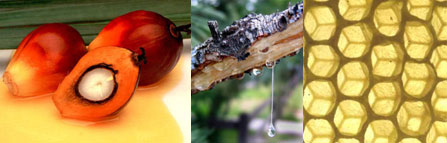
Tree resin
Grown on New Zealand's rugged west coast, the pine tree (Pinus Radiata) is the perfect source for our pure tree rosin. Containing a group of beneficial fatty acids, tree rosin can aid in the natural breakdown of over-production of keratin, which is present in eczema -prone and dry, cracked skin. The rosin allows these cells to shed, promoting the growth of new cells. Tree rosin may also break down collagen, found present in scar tissue, and is a mild astringent, which can help dry out acne spots and cold sores.
It is also interesting to note that bees create propolis by collecting a resinous sap from trees and then mixing it with wax back at the hive. Chemically, propolis is exceedingly complex and contains a rich variety of potent terpenes and benzoic, caffeic, cinnamic, and phenolic acids. It is also high in flavonoids, which by themselves may account for many of the benefits attributed to propolis. Some researchers refer to propolis as a type of flavonoid.
Propolis acts against viruses, which antibiotics do not. A number of medical journal reports have discussed the role of propolis in fighting upper respiratory infections, such as those caused by the common cold and influenza viruses (Focht J, Arzneimittel-Forschung, Aug. 1993;43:921-3). Other investigators have reported that the cinnamic acid extracts of propolis prevent viruses from reproducing, but they worked best when used during the entire infection (Serkedjieva J, Journal of Natural Products, March 1992;55:294-302).
Underpinning many of the benefits of propolis is the fact that some of its components, such as flavonoids and ethanols, function as antioxidant free-radical scavengers. A study published in the Journal of Ethnopharmacology (Jan. 1994;21:9-13) noted that some of the antioxidant phenols in propolis functioned similarly to vitamin E. In another article, researchers described that propolis had anti-inflammatory properties and that it could also prevent blood clots (Drugs Under Experimental & Clinical Research, 1993; 19:197-203). 
Palm oil
Sourced from family-owned plantations high in the mountains of Colombia, our guilt-free organic palm oil offers the best of the palm without endangering the rainforests or the Orang-utans that inhabit them. High in the antioxidant vitamin E (alpha tocopherol) and vitamin K, palm oil aids in the repair of dry, rough skin. Vitamin E is also recognised for its proven ability to help retain moisture in the skin while the high levels of vitamin K can aid in the repair of skin cells and damaged capillaries, helping tissue to heal.
"The discovery [of palm oil] could make the ingredient a useful alternative to treat a host of skin care conditions such as eczema, dermatitis or acne that can often permanently scar or damage the skin," Musalmah Mazlan, study leader on the effects of palm oil, University of Kebangsaan, Malaysia
Our organic palm oil is supplied by a member and sponsor of the Round Table on Sustainable Palm Oil, a worldwide organisation of palm growers, refiners and importers who are committed to sustainability.
Palm oil and tocotrienol
Palm oil is the largest natural source of tocotrienol, part of the vitamin E family. Palm oil is also high in vitamin K. According to studies carried out at the University of Kebangsaan, palm oil has several potent healing and protecting qualities, as explained below.
Anti-aging / cosmetics and personal care
- Preferentially accumulates at the strata corneum of the skin. First line of defense against free radicals generated in the skin by UV/ozone rays. Prevention of skin aging and damage by oxidative rays. Being a more potent antioxidant, the tocotrienols neutralise free radicals at a faster rate and hence protect tocopherols.
- Protection against UV-induced skin damage and skin aging.
- Tocotrienols topically applied onto the skin were found to penetrate rapidly through the skin and the highest concentrations are found in the uppermost five microns.
- Tocotrienol-treated skin contained vitamin E at concentration 7-30 fold higher than control values.
- Tocotrienol augments the efficacy of sunscreens containing compounds that reduce penetration of or absorb ultraviolet radiation.
Other Interesting functions of Palm oil and tocotrienol
Anti-cancer and tumour suppressant
- Palm based tocotrienols have shown to inhibit human breast cancer cells irrespective of estrogen receptor status.
- Delta-tocotrienol was found to be the most effective tocotrienol in inducing apoptosis (cell death) in estrogen-responsive and estrogen-nonresponsive human breast cancer cells.
- Confers anti-cancer properties.
- Inhibits tumor growth of certain cancers.
- Alpha-tocotrienol and gamma-tocotrienol have shown to prolong the life span of cancer-infected mice.
- Gamma-tocotrienol is three times more potent in inhibiting growth of human breast cancer cultured cells than Tamoxifen.
Potent natural super-antioxidant
- Alpha-tocotrienol has been shown to be 40 - 60 times more potent than alpha-tocopherol as an antioxidant in the prevention of lipid peroxidation.
- Delta-tocotrienol is the most potent antioxidant (highest antioxidant potency) of all commercially available tocotrienols and has been shown to be the most effective tocotrienol in inhibiting human breast cancer and liver cancer cells.
- Effective antioxidant in the prevention of protein oxidation and lipid peroxidation after strenous exercise for athletes, joggers and body builders.
See also:

Sustainably sourced guilt free palm oil
All palm oil used in our products is sourced from family farms in Colombia and is certified organic.
View our suppliers Ecocert certificate here
Organic palm oil is supplied by a member and sponsor of the Round Table on Sustainable Palm Oil www.rspo.org a world-wide organisation of palm growers, refiners and importers who are committed to sustainability. Our palm oil comes from Colombia, so there is absolutely no infringement on the South East Asian orangutans' habitat.
The Round Table on Sustainable Palm Oil has created a certification procedure and seal that identifies palm oil growers and refiners who meet these standards. The farming and refinery operators of our supplier have been certified by ProForest www.proforest.net which ensures that they meet strict social, environmental and technical criteria. With regard to environmental criteria, the ProForest assessments are carried out at the landscape and operational level at both the plantations and processing facilities. These assessments cover environmental impact on the soil, water, air, biodiversity and local communities. This certification protects natural forest by ensuring that no plantations are planted on lands deforested since the end of 1994.
Certified by: ECOCERT SA F-32600 |
